
Apollonia Archaeological Park Travel Guide
Explore the remains of an important Greek and Roman city on a hillside near Pojan, west of Fier. Monumental civic buildings, colonnades and finds displayed in the medieval Monastery of Saint Mary make this one of southwestern Albania’s most substantial archaeological stops.
- Best for
- Archaeology and history
- Visit style
- Half-day cultural stop
- Nearest base
- Fier
Why explore Apollonia Archaeological Park?
Founded by Greek colonists and later developed under Roman rule, Apollonia became an important city connected to the Adriatic world. Its remains extend beyond the best-known monumental façade to include public, religious and performance buildings spread across the hillside.
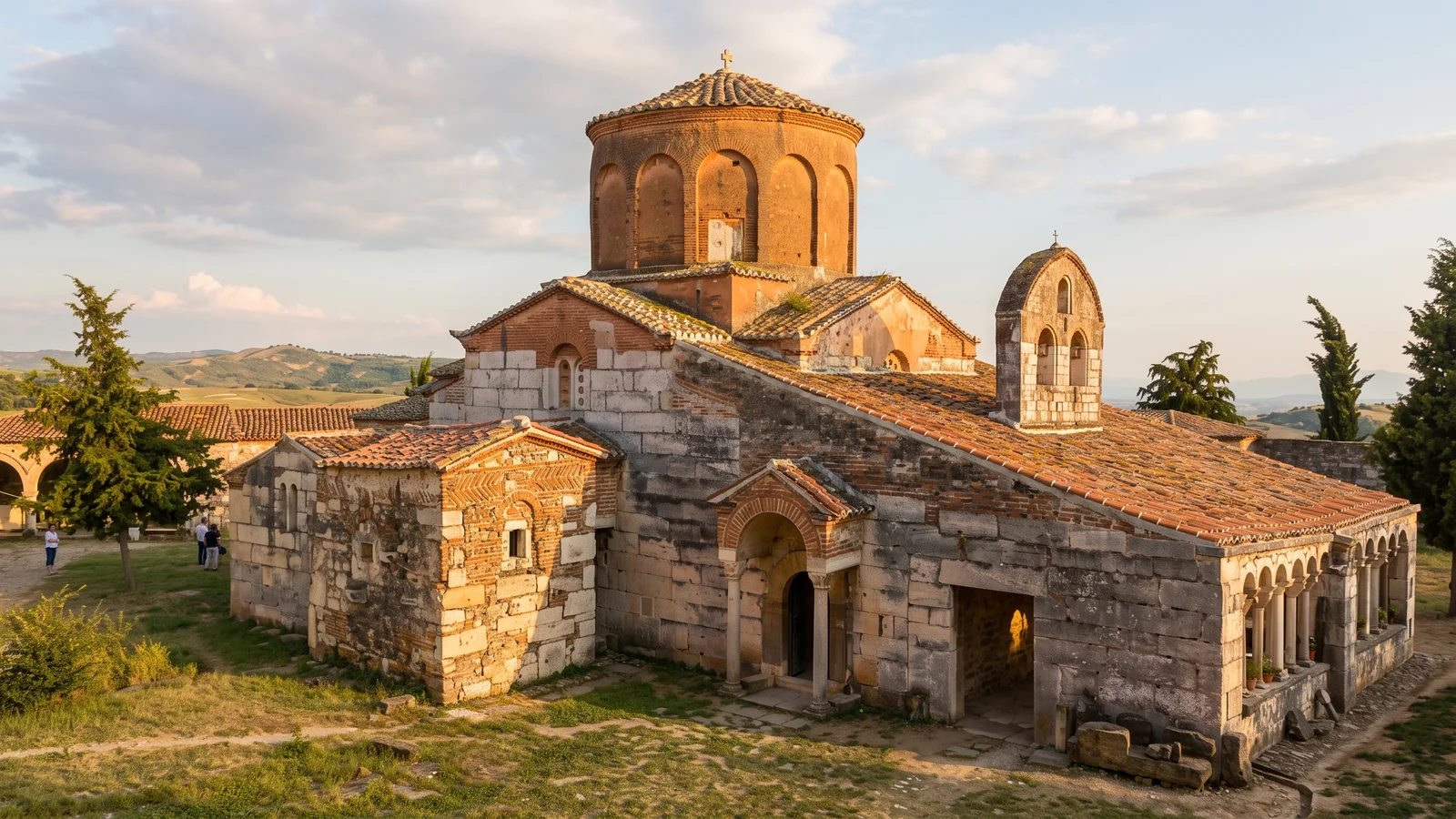
The park is especially valuable for the way its layers meet: an ancient civic centre, a broad archaeological landscape and the medieval Monastery of Saint Mary, which houses finds excavated at the site.
Read the full overview
Together they reveal more of the city’s scale and history than any single ruin could convey.
Know before you go
Check the park’s current opening schedule, ticket price and museum access before making a dedicated journey. Published operational details can differ and may change by season.
- Time needed
- About 2–3 hoursA fuller exploration of the wider park and museum can take 3–4 hours.
- Opening hours
- Check before visitingSeasonal schedules and weekly closures may change.
- Tickets
- Confirm current priceCheck available categories and whether museum access is included.
- Terrain
- Uneven hillside siteA complete visit involves paths, rough sections and uphill walking.
- Museum access
- Confirm on the dayDo not plan the visit on the assumption that every area will be open.
- Booking
- Ask for guided visitsConfirm arrangements directly if you want a guide or are travelling with a group.
Getting to Apollonia Archaeological Park
The park is near Pojan, west of Fier. A car or taxi provides the most dependable final connection; travellers using intercity transport normally need to change in Fier.
Monuments of ancient Apollonia
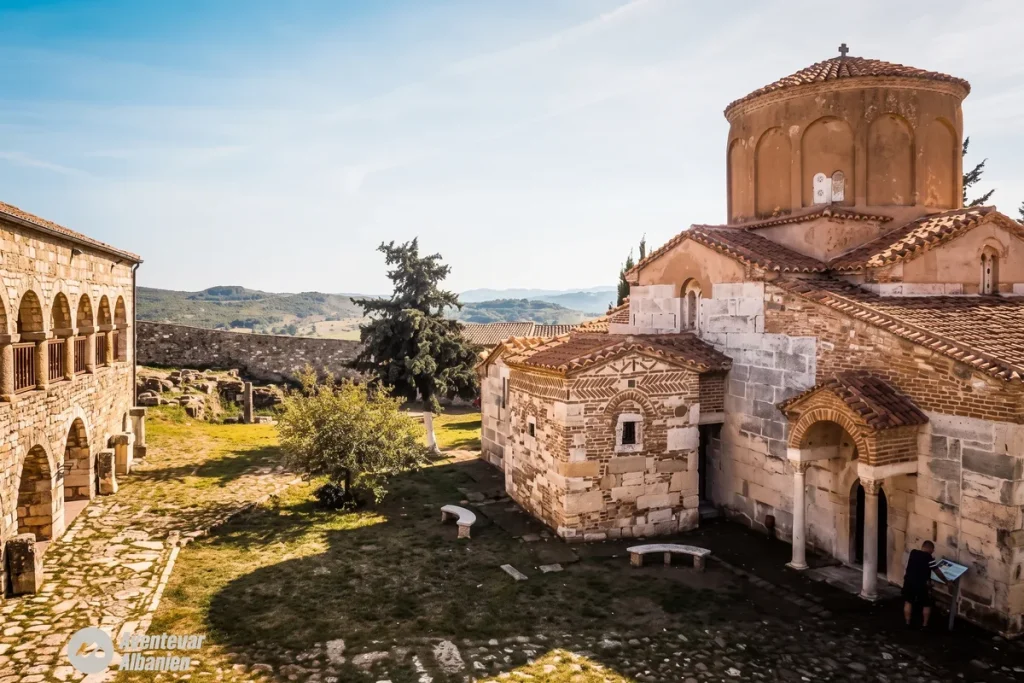
Start with the concentrated group of public buildings near the ancient civic centre, then continue through the wider archaeological landscape toward the higher ground and the Monastery of Saint Mary.
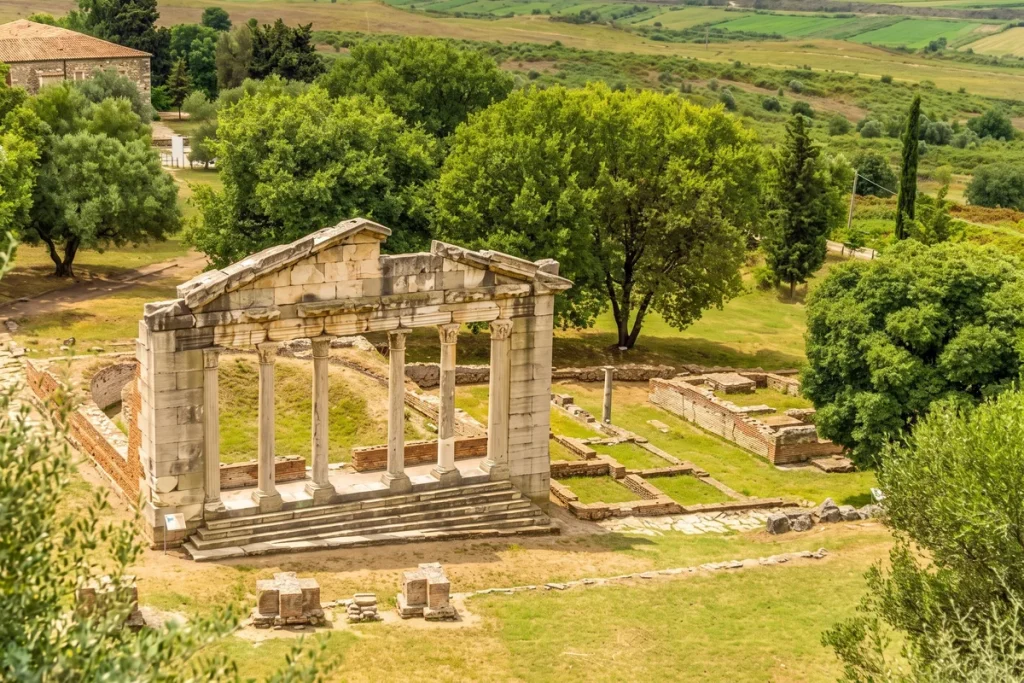
The civic centre offers the most immediately legible remains, particularly the façade of the Agonothetes building and the nearby Odeon. Beyond it, colonnades, foundations and waterworks show that Apollonia was an extensive city rather than a small sanctuary or isolated Roman monument.
Finish at the monastery and museum if access permits. Seeing excavated objects after the ruins helps connect the surviving architecture with the people, institutions and artistic traditions of ancient Apollonia.
Plan your time on site
What to see
- Monument of the AgonothetesOften identified as Apollonia’s bouleuterion, this Roman-period civic building is the park’s architectural focal point. Its reconstructed Corinthian façade gives the clearest impression of the monumental public centre.
- OdeonThis compact Roman performance building stands close to the civic centre. Its curved seating helps explain how entertainment and public gatherings fitted into the ancient urban plan.
- Great StoaThe long colonnaded structure follows the Greek tradition of covered public space used for meeting, walking and civic activity. Its length conveys Apollonia’s scale more effectively than isolated fragments do.
- NymphaeumThis monumental fountain complex formed part of the ancient city’s water infrastructure. Although less immediately recognisable than the civic buildings, it illustrates the engineering and investment required to support urban life.
- AcropolisThe upper part of the ancient city contains more fragmentary remains. Its elevated position helps visitors understand how widely Apollonia extended across the hillside and how the city related to the surrounding plain.
- Monastery and museumThe medieval Monastery of Saint Mary houses the archaeological museum. Sculptures, inscriptions and other excavated objects restore detail and human context that can be difficult to read from exposed foundations alone.
Plan ahead
- The reconstructed façade near the civic centre is only one part of Apollonia. Much of the ancient city survives as foundations, architectural fragments and dispersed structures, so the experience depends on connecting remains across a broad landscape. Visitors expecting a short circuit of fully standing monuments may find the site less immediately legible than its best-known photographs suggest.
- Walking shoes Wear supportive footwear — Paths include rough and uphill sections across the archaeological area.
- Drinking water Carry your own — Refreshment availability is uncertain, especially outside the busiest travel periods.
- Sun protection Bring hat and sunscreen — Many of the principal remains stand in open ground.
- Archaeological museum Inside the monastery — Confirm that it is accessible on the day of your visit.
Is Apollonia Archaeological Park right for you?
Best suited to
- Archaeology enthusiasts — The combination of a civic centre, performance building, stoa, waterworks and museum offers more depth than a single-monument stop.
- Cultural road trippers — The park fits naturally into a journey linking Fier with Berat or Vlora without requiring an overnight stay beside the ruins.
- Independent history visitors — Travellers prepared to study fragmentary foundations will find a broad ancient city beyond the reconstructed monumental façade.
- Families with older children — The mix of ruins, open space and museum objects can engage children already interested in Greek or Roman history.
May not suit
- Visitors with reduced mobility — The hillside setting, uneven sections and distances between remains may prevent some visitors from completing the wider circuit.
- Heat-sensitive travellers — Exploring the open archaeological areas can be strenuous during hot weather.
- Time-critical no-car trips — An itinerary dependent on precise connections is vulnerable to uncertainty on the final leg from Fier.
For younger children, judge the visit by their tolerance for sustained outdoor walking; the park is not a compact, stroller-oriented attraction.
Before you go
Practical details to check before visiting Apollonia Archaeological Park.
- Best time
- April–May, September–OctoberMilder conditions make outdoor exploration more comfortable.
- Summer strategy
- Visit in the morningThe open archaeological areas can become demanding in hot weather.
- Location
- Near Pojan, west of FierThe park lies on a hillside above the Myzeqe plain.
- Food and drink
- Do not rely on a caféBring water, as availability of on-site refreshments can change.
Planning your Apollonia visit
Practical answers to help you plan your visit.
Is Apollonia worth visiting without a guide?
Yes, especially if you are comfortable reading archaeological plans and fragmentary remains. A guide is most useful for explaining how the Greek city developed under Roman rule and for identifying less obvious structures beyond the civic centre.
Why is Apollonia associated with Augustus?
The future emperor Augustus, then known as Octavian, was studying at Apollonia when news arrived of Julius Caesar’s assassination in 44 BC. The connection underlines the city’s intellectual standing in the late Roman Republic.
Can Apollonia be combined with Ardenica Monastery?
Yes. Ardenica Monastery provides a contrasting medieval religious site in the wider Fier area and makes a more coherent pairing than adding another extensive archaeological park on the same day.
Is the Monastery of Saint Mary itself part of the visit?
Yes. The medieval monastery forms an important layer of the site and contains the archaeological museum, linking Apollonia’s later religious history with objects recovered from the ancient city.
What should I focus on during a shorter visit?
Prioritise the civic centre around the Monument of the Agonothetes and Odeon, then see the monastery and museum if accessible. This captures the strongest architecture and the most useful historical context without attempting the entire hillside.